Resister · 1921-1944
Hannah Szenes
On her way to the last border she handed a fellow parachutist four lines of verse. Captured within hours, she gave her interrogators her name and nothing that would cost another life.
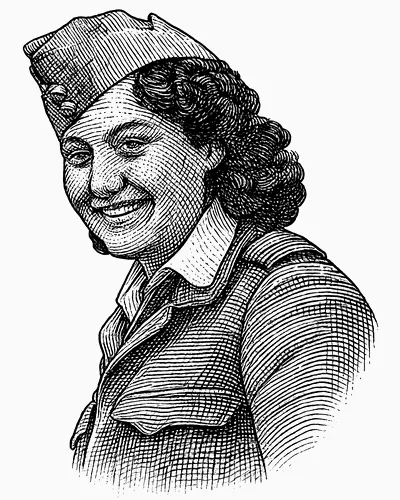
A Budapest poet
Hannah Szenes was born on 17 July 1921 in Budapest. Her father, the playwright and journalist Béla Szenes, died when she was six. She kept a diary from the age of thirteen. As antisemitism rose in Hungary she began studying Hebrew and joined a Zionist youth movement, and in 1939, aged eighteen, she emigrated to Mandatory Palestine to study at the agricultural school at Nahalal. In 1941 she joined Kibbutz Sdot Yam on the coast. She wrote in Hebrew, and a poem written at Caesarea in 1942 was later set to music as the song "Eli, Eli."
The parachutists
By 1943 the news from Europe was impossible to ignore. About 250 volunteers in Palestine came forward for a British-backed mission to parachute behind enemy lines, and about thirty were chosen. Hannah, twenty-two and trained as a wireless operator, was one of them. She parachuted into Yugoslavia on 14 March 1944. Five days later Germany occupied Hungary, which made the mission far more dangerous. Some of her companions hesitated; she saw it as a reason to hurry.
Blessed is the match
While she waited in Yugoslavia, she wrote four lines of verse in Hebrew about a match spent in kindling a flame. Before crossing the border she handed the poem to a fellow parachutist, Reuven Dafni. It became the most quoted sentence any of the parachutists wrote.
Capture and refusal
She crossed into Hungary in June 1944 and Hungarian gendarmes captured her within hours, finding the British transmitter she carried. In Budapest she was interrogated and beaten for weeks, but she gave up her name and nothing else, and not the transmitter code. The authorities arrested her mother, Catherine, to pressure her, and she still refused. She was tried for treason on 28 October and would not plead for clemency. She was executed by firing squad in Budapest on 7 November 1944, aged twenty-three.
Remembered
Catherine Szenes survived, reached Palestine and published her daughter's diary and poems. "Eli, Eli" is sung throughout Israel. Hannah's remains were reburied on Mount Herzl in Jerusalem in 1950, Kibbutz Yad Hannah was founded in her memory and a Hungarian court formally exonerated her in 1993.
Blessed is the match consumed in kindling flame.Hannah Szenes, 1944
Further reading
- Szenes, Hannah. Hannah Senesh: Her Life and Diary.
- Atkinson, Linda. In Kindling Flame: The Story of Hannah Senesh, 1921-1944. Lothrop, Lee & Shepard, 1985.
- Baumel-Schwartz, Judith Tydor. Perfect Heroes: The World War II Parachutists and the Making of Israeli Collective Memory. University of Wisconsin Press, 2010.
- Jewish Women's Archive, "Hannah Szenes."
In the book
Hannah Szenes is one of the 36 women whose documented stories are told in Women Without Fear, a book and documentary project of The Legacy Project. The book is being prepared for publication. You can read one full sample chapter now, on Róża Robota.