Resister · 1921-1945
Róża Robota
She never held a weapon. She held a seam, and under three months of torture, she did not come apart.
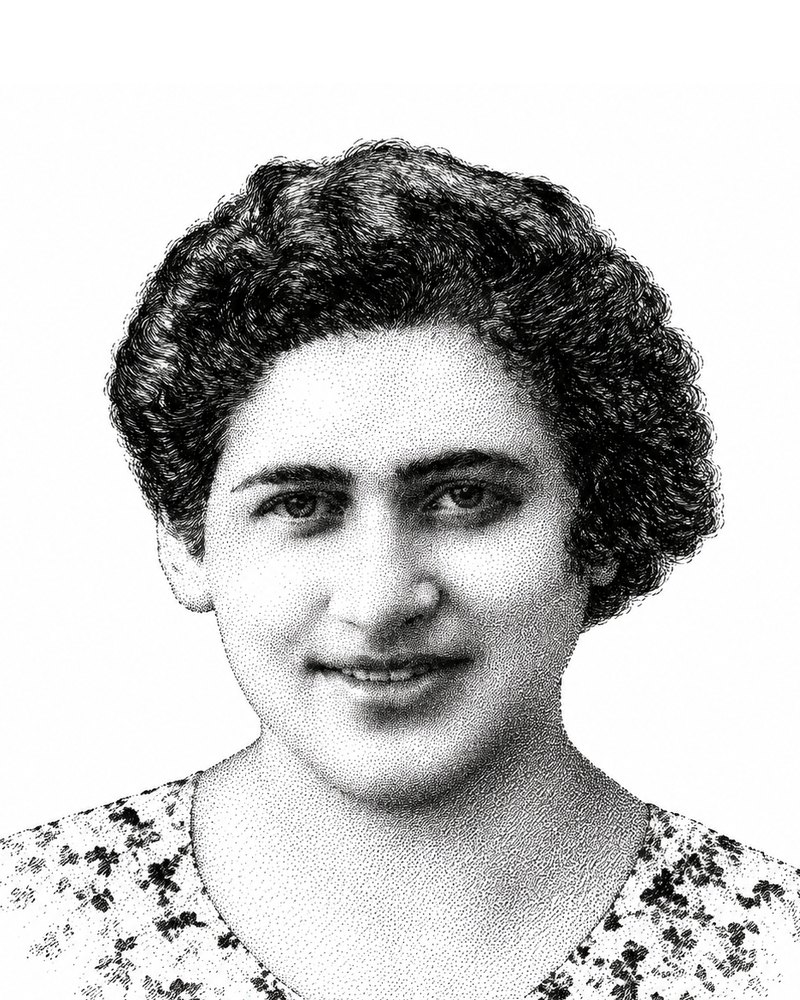
A seam that hid a revolt
Róża Robota never fired a shot or set a fire. Her part in the only armed revolt ever staged inside a Nazi death camp passed through her hands in grains too small to see: gunpowder folded into a hem, a knotted headscarf, the seam of a dress. Chapter 23 of Women Without Fear, "The Seam," tells her story.
From Ciechanów to Auschwitz
She was born in 1921 in Ciechanów, Poland, finished grammar school with honors and joined Hashomer Hatzair, the Zionist-socialist youth movement. When the Ciechanów ghetto was sealed, she took its discipline into the ghetto underground. In November 1942 the ghetto was liquidated and she was deported to Auschwitz-Birkenau with her parents, sister and brother. On arrival she was the only one of them selected for work. She never saw her family again.
The clothing depot and the chain
Róża Robota was put to work in the Effektenlager, the clothing depot the prisoners called Canada, sorting the belongings of the murdered. The camp underground recruited her there, drawn in by fellow natives of Ciechanów. She became the receiving link in a chain: women working the Weichsel-Union-Metallwerke munitions factory stole gunpowder by the pinch, and it reached her hands and then the Sonderkommando, the men forced to operate the gas chambers and crematoria, who were secretly preparing to fight.
The revolt of 7 October 1944
Over months in 1944 the stolen powder added up to enough to arm a revolt. On 7 October 1944, Sonderkommando prisoners at Crematorium IV, warned that their unit was scheduled for liquidation, attacked their SS guards and set the building alight. Crematorium IV was destroyed and three SS men were killed, but the revolt was put down within hours, with the reprisals costing hundreds of prisoners' lives.
Block 11 and her refusal
The SS traced the powder back through the chain within days. Four women were arrested and taken to Block 11, Auschwitz I's punishment block: Róża Robota, Ala Gertner, Regina Safirsztajn and Ester Wajcblum. For roughly three months Róża Robota was held and tortured. She knew every name in the chain and gave up none of them. Through the courier Noah Zabludowicz she sent word to her comrades that she had not betrayed them, with the Hashomer Hatzair watchword from the Book of Joshua: Hazak ve'ematz, be strong and of good courage.
Remembered by name
On 6 January 1945 Róża Robota, Ala Gertner, Regina Safirsztajn and Ester Wajcblum were hanged before the assembled prisoners of the Birkenau women's camp, the last public execution carried out at Auschwitz. Auschwitz was liberated by the Red Army on 27 January 1945. Her story has been carried forward by survivor testimony, including that of Anna Heilman, the sister of Ester Wajcblum. It is taught by name in Holocaust education programs, a foundation in her name funds Holocaust education and commemoration, and a monument at Yad Vashem holds her name beside the other three.
She never held a weapon. She held a seam.Women Without Fear, Chapter 23
Further reading
- Suhl, Yuri. They Fought Back: The Story of the Jewish Resistance in Nazi Europe. Crown, 1967.
- Heilman, Anna. Never Far Away: The Auschwitz Chronicles of Anna Heilman. University of Calgary Press, 2001.
- Jewish Women's Archive, "Roza Robota."
- United States Holocaust Memorial Museum, Holocaust Encyclopedia, "Prisoner Revolt at Auschwitz-Birkenau."
- Yad Vashem, biographical record, "Robota, Rosa."
Read her chapter
Róża Robota is one of the 36 women whose documented stories are told in Women Without Fear, a book and documentary project of The Legacy Project. Her full chapter opens in the reader on its first page, with no sign-up needed.