Resister · 1914-1978
Zivia Lubetkin
She would not send a fighter into a street she was not willing to stand in herself, and she came up out of the sewer last.
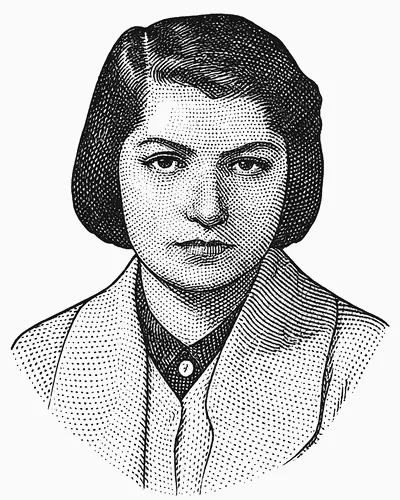
The only woman at the table
Zivia Lubetkin was born in 1914 in Byten, one of seven children. She came to Warsaw as a teacher and organizer for Dror, the Socialist-Zionist youth movement, and joined its executive council in 1938. When the Jewish Fighting Organization (ŻOB) was formed on 28 July 1942, she was the only woman on its first High Command, alongside Shmuel Braslav, Josef Kaplan, Mordechai Tenenbaum and Yitzhak Zuckerman.
A rule of command
Her rule was that she would never send a fighter into a street she was not willing to stand in herself. She gave hard orders to people's faces. She built weapons-procurement networks, supervised training across movement lines and kept rival movements, Dror, Hashomer Hatzair and the Bund, from splintering under pressure.
The uprising, April 1943
When the SS moved to liquidate the Warsaw Ghetto on 19 April 1943, Lubetkin commanded a fighting unit in the streets, coordinating ambushes from windows with handmade grenades. The SS had promised themselves the ghetto in three days. The uprising held for nearly four weeks.
Through the sewers
By 10 May 1943 the uprising was collapsing. Regina Fudem had mapped routes to the Aryan side, and Lubetkin led the last survivors through some eleven hours of flooded tunnels in darkness. She insisted on going last among the commanders and came up out of the ground behind the last of her people. In 1944 she fought again as a commander in a ŻOB platoon during the Warsaw Uprising.
Witness and builder
Lubetkin reached Palestine in 1946 and in 1949 co-founded Kibbutz Lohamei HaGeta'ot with Yitzhak Zuckerman, her comrade and husband, and helped establish the Ghetto Fighters' House, an archive and museum for the story of the uprising. In 1961 she testified at the Eichmann trial in Jerusalem. She died on 11 July 1978, aged 63. Her memoir was published the following year, and in it she insisted that resistance was collective.
Our fate would have been very different had we not been members of the movement.Zivia Lubetkin, memoir, quoted in Women Without Fear, Chapter 2
Further reading
- Lubetkin, Zivia. In the Days of Destruction and Revolt. Ghetto Fighters' House / Hakibbutz Hameuchad, 1981.
- Zuckerman, Yitzhak (Antek). A Surplus of Memory: Chronicle of the Warsaw Ghetto Uprising. University of California Press, 1993.
- Gutman, Israel. Resistance: The Warsaw Ghetto Uprising. Houghton Mifflin, 1994.
- Yad Vashem, "Zivia Lubetkin," biographical entry and Eichmann-trial testimony.
In the book
Zivia Lubetkin is one of the 36 women whose documented stories are told in Women Without Fear, a book and documentary project of The Legacy Project. The book is being prepared for publication. You can read one full sample chapter now, on Róża Robota.