Resister · 1903-1976
Rachel Auerbach
She recorded the Warsaw Ghetto while it was still standing, and then spent thirty years making sure the testimony was heard.
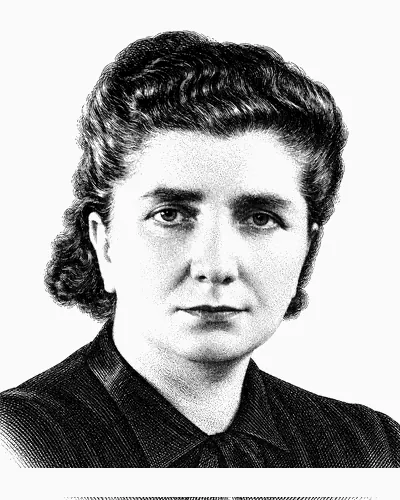
A Yiddish writer
Rachel Auerbach was born on 18 December 1903 in Łanowce and grew up in Lwów. She became a Yiddish writer and editor and moved to Warsaw in 1932.
Oyneg Shabes
In 1940 Emanuel Ringelblum recruited her into Oyneg Shabes, the secret archive of the Warsaw Ghetto. She ran the soup kitchen at 40 Leszno Street and recorded hundreds of interviews between 1940 and 1943. She wrote the essays "Two Years in the Ghetto" and "Gets a teler esn".
Treblinka
From 28 December 1942 to 7 March 1943 she recorded the testimony of Jacob Krzepicki, an escapee from Treblinka. On 9 March 1943 she crossed to the Aryan side as "Aniela Dobrucka". She wrote at night, from midnight to five in the morning, and produced "Oyf di felder fun Treblinke" (On the Fields of Treblinka). She was one of only three people connected with Oyneg Shabes to survive.
Recovering the archive
In September 1946 she led the excavation at 68 Nowolipki Street that recovered part of the archive. In 1950 two milk cans holding Ringelblum's diary and essay were also recovered. She co-founded the Central Jewish Historical Commission.
Yad Vashem
On 1 March 1954 Auerbach founded Yad Vashem's Department for the Collection of Witness Testimony. By 1959 it held about 2,800 testimonies in 15 languages, and by 1965 about 3,000. She testified at the Eichmann trial on 3 May 1961, retired in 1969, and published "Warsaw Testaments" and "On the Last Journey" (1974). She died in Tel Aviv on 31 May 1976, aged 72.
Further reading
- Auerbach, Rachel. Varshever Tsavoes. Tel Aviv: Yisroel-Bukh, 1974.
- Auerbach, Rachel. Behutsot Varsha. Am Oved, 1954.
- Kassow, Samuel D. Who Will Write Our History? Emanuel Ringelblum, the Warsaw Ghetto, and the Oyneg Shabes Archive. Indiana University Press, 2007.
- Wikipedia: Rachel Auerbach
Related profiles
In the book
Rachel Auerbach is one of the 36 women whose documented stories are told in Women Without Fear, a book and documentary project of The Legacy Project. The book is being prepared for publication. You can read one full sample chapter now, on Róża Robota.